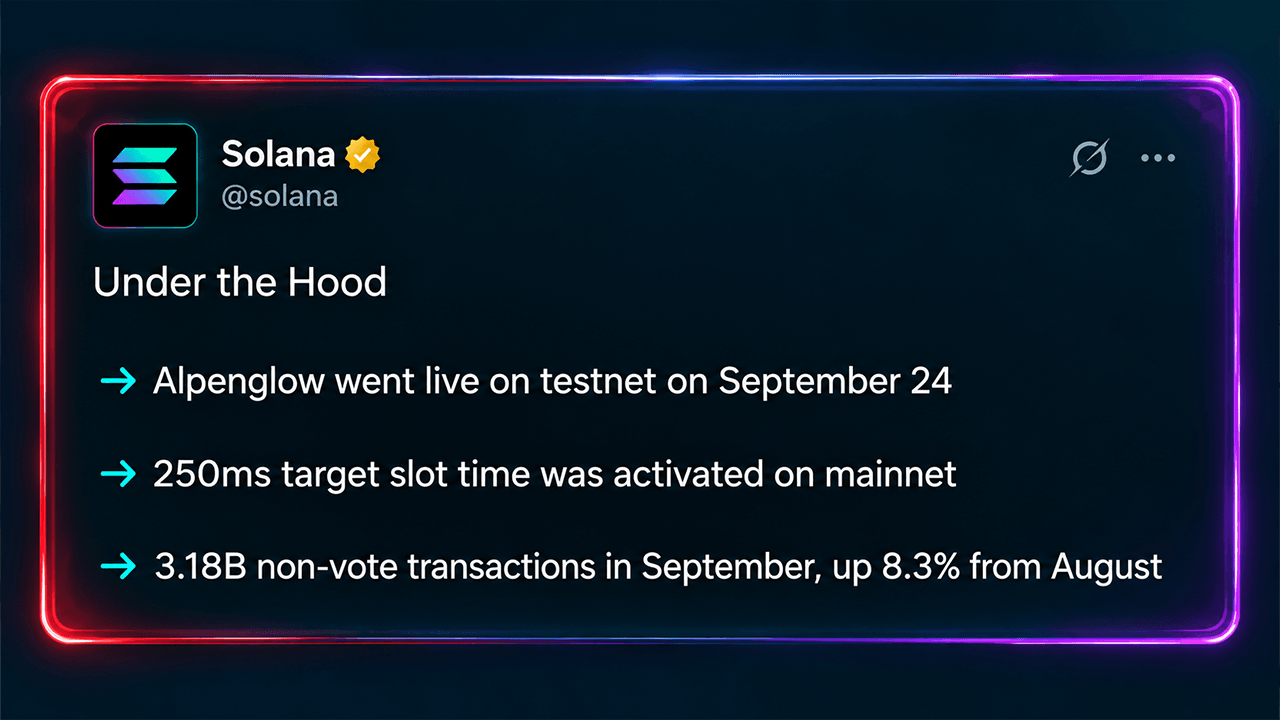
Key Takeaways
- Solana’s biggest consensus overhaul is set for Oct. 21, with Alpenglow promising to cut transaction finality from 12.8 seconds to just 150 milliseconds.
- The upgrade replaces Solana’s existing voting system with Votor, allowing validators to reach agreements much faster without putting every vote onchain.
- Despite the excitement surrounding Alpenglow, SOL is trading near $106, down 10% over two weeks and nearly 64% below its all-time high.
Solana Prepares for Its Biggest Consensus Overhaul
“It’s time,” Anza wrote on the social media platform X. “Alpenglow goes live on mainnet-beta Wednesday, October 21, ~14:50 UTC. 18 months of work for a migration that happens in one slot. Finality drops from seconds to ~150ms.”
Bitcoin.com News reported on the upgrade in March, explaining how Alpenglow will be Solana’s largest consensus redesign. At press time, the chain takes around 12.8 seconds to finalize a transaction, known as “finality” in blockchain spaces. When the upgrade is complete, Solana is expected to make finality a whole lot faster, to around 150 milliseconds, or 0.15 seconds.
The Layer 1 (L1) project started testnet implementations last month and Solana co-founder Anatoly Yakovenko told the public, “You are not ready for this.” Currently, the L1 leverages a scheme called TowerBFT to help its validators agree on transactions. Under the existing design, validators submit votes through the blockchain itself. This takes time and uses network capacity.
Votor Replaces Onchain Voting With Faster Validator Consensus
Documentation covering the Alpenglow roadmap indicates that the upgrade will introduce a replacement called Votor. Instead of placing all those votes on the blockchain, validators can communicate directly with one another. Essentially, their votes will then be combined into smaller records that confirm an agreement. It’s akin to replacing a lengthy approval process with a much faster electronic vote.
The latest announcement has not bolstered SOL’s price, as Solana’s native token has shed 10% over the last two weeks. Year-to-date statistics show a near 15% decline, and SOL is still down roughly 64% below its $293 all-time high recorded in January 2025.
As of today, Oct. 15, 2026, SOL is exchanging hands for about $106, and it has gained a percentage point over the last day.
An 18-Minute Transition and an 82% Staking Threshold
As far as the upgrade is concerned, Solana will not immediately switch everything over. Instead, the network will continue using its existing system for approximately 18 minutes. During that period, blocks will contain validator votes rather than ordinary user transactions. This gives operators a controlled period to prepare for the change. Solana has explained that once the validator set reaches at least 82% of staked SOL, the L1 will switch to Votor.
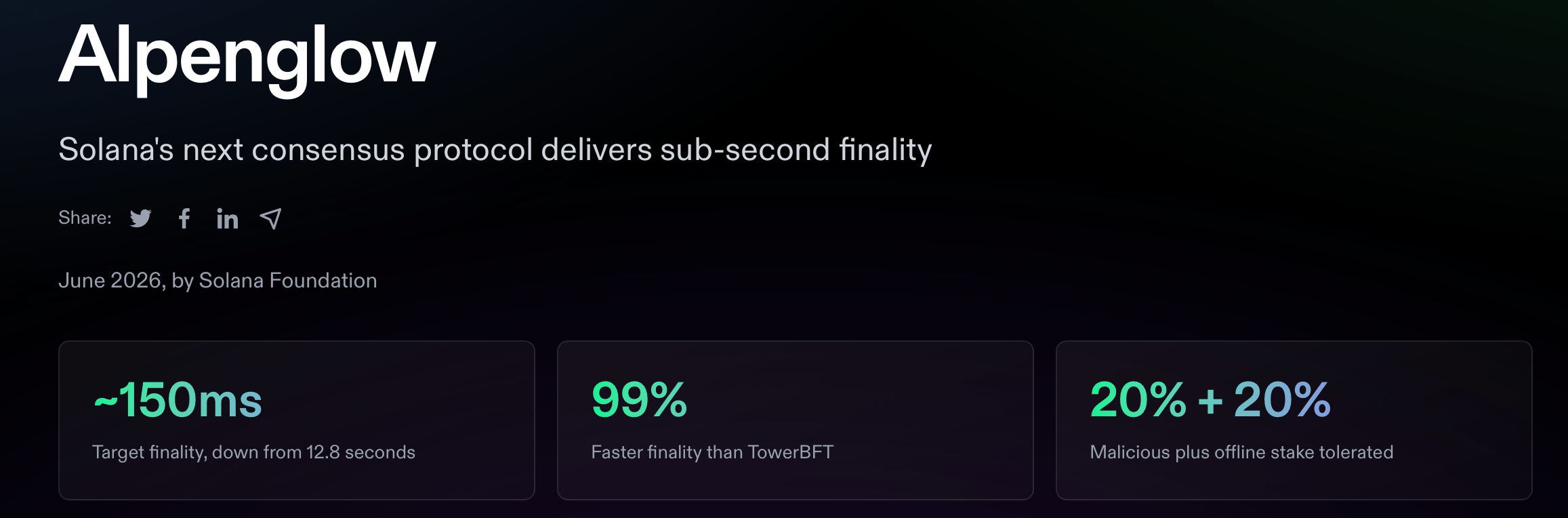
Alongside this, Alpenglow has two major components, but only Votor is scheduled for Oct. 21. The second part of the upgrade will be what’s called Rotor, a design that will change how new blocks are distributed among validators. Its purpose is to make that communication process simpler and more efficient. At the time of writing, Rotor does not yet have an activation date. For now, the L1 Solana is concentrating on replacing its consensus system, the mechanism that allows the network to agree on which transactions are final.