Key Takeaways
- Bitcoin spiked past $64,000, triggering $220 million in market liquidations amid heavy short squeezes.
- Strategy distributed common stock sale proceeds toward $4.8B cash reserves and preferred stock actions.
- MSTR equity holders face value dilution from STRC share buybacks while bitcoin purchases remain frozen
Rapid Intraday Recovery Drives Liquidations
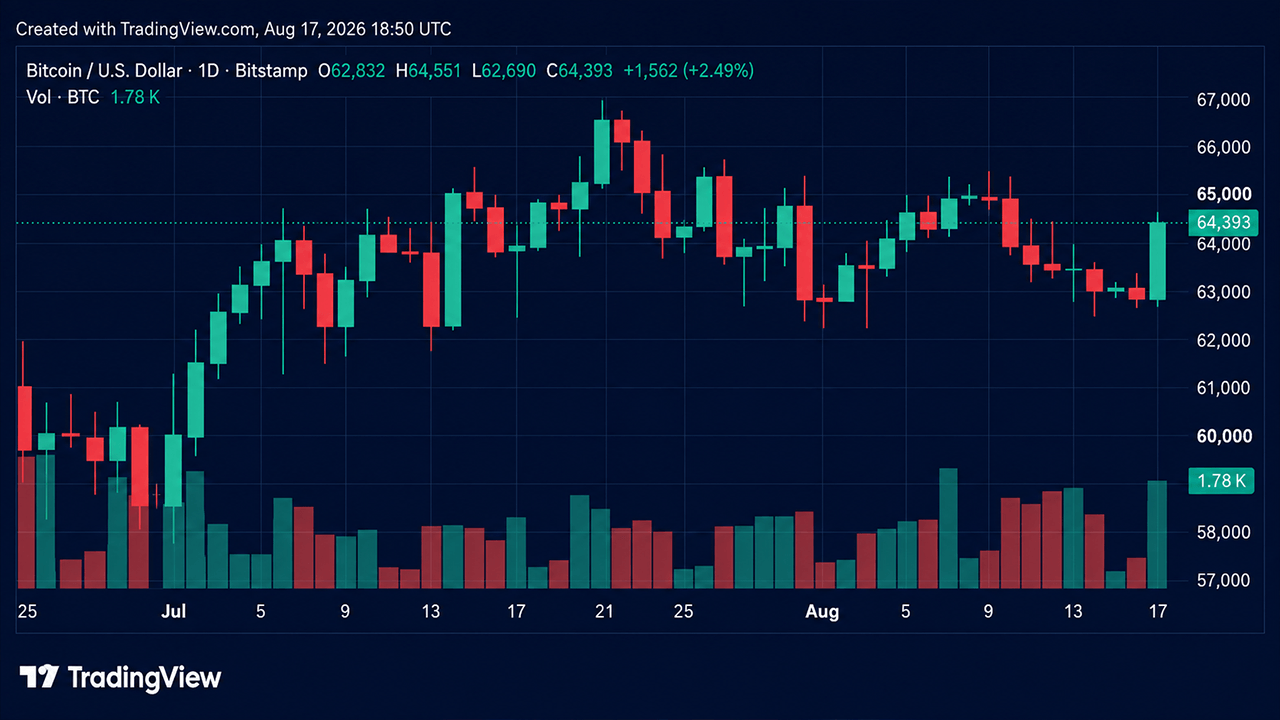
On Monday, bitcoin reclaimed the $64,000 threshold just hours after the cryptocurrency fell below $63,000 and appeared on course to match its Aug. 14 lows. The cryptocurrency’s rebound coincided with Strategy’s announcement that it neither sold nor bought new coins in the past week.
Daily market data showed the top cryptocurrency initially trended downward as it tumbled from just over $63,100 to an intraday low of $62,653. However, starting a few hours before midnight, bitcoin reversed course as it kicked off a steady climb that added approximately $1,000 to its value in six hours. It held in the $63,500 range until 10:45 a.m. EST, when a sudden spike saw it breach the $64,000 mark and tap an intraday high of $64,375.
At the time of writing (1:30 p.m. EST), the cryptocurrency was trading above $64,200, translating to daily gains of close to 2%. The increase briefly pushed its market capitalization past the $1.29 trillion mark and turned its weekly gains from negative to plus 0.5%. On the derivatives market, bitcoin’s ascent left short sellers licking their wounds.
Coinglass data showed bitcoin’s 24-hour price action resulted in $57.4 million in liquidated leveraged short positions, compared to $13.3 million in long bets. During the same period, liquidations across the cryptocurrency market reached nearly $220 million, with short bets accounting for approximately $155 million.
Despite not selling bitcoins, Strategy increased its dollar reserves to $4.8 billion using part of the $333.7 million raised from selling its common stock. It also used the proceeds to repurchase 1,388,720 STRC shares for $132.2 million and pay $52.4 million in preferred stock dividends.
Some analysts believe the expansion of Strategy’s cash reserves virtually eliminates short- to mid-term liquidation pressure for preferred dividends or debt servicing. With bitcoin trading approximately 15% below Strategy’s $75,385 average acquisition cost, analysts argue management is prioritizing balance sheet health and defending against share dilution over adding to unrealized losses.
Although market participants broadly welcomed the suspension of bitcoin liquidations, skeptics maintain that Strategy’s capital allocation strategy disproportionately shifts value away from MSTR equity holders toward STRC preferred holders. Furthermore, by explicitly mothballing its primary catalyst of aggressive bitcoin acquisition until STRC trades back at par value and target liquidity thresholds are met, Strategy has effectively sidelined the company’s core thesis, deal-striking a blow to long-term bitcoin bulls.
Meanwhile, bitcoin appeared to respond positively to reports that the U.S. and Iran agreed to extend a Pakistan-brokered 60-day ceasefire expected to end today. Analysts viewed the reported agreement as bullish for markets, and bitcoin’s price movement seemingly aligned with that assertion.
That bullish thesis, however, quickly unraveled after Iranian officials refuted reports of an extended truce. With no formal confirmation regarding the status of the ceasefire at the time of writing, bitcoin remains deprived of the macro catalyst needed to sustain a decisive breakout.