Circle minted approximately 250 million USDC on the Solana network inside a six-hour window, according to on-chain monitoring data from SolanaFloor – and the headline number is only the starting point.
Events like this are often framed as straightforward bullish signals, but the actual implication is more nuanced: fresh stablecoin supply is dry powder, not deployed capital, and the difference matters enormously for how SOL traders should read the data. This article unpacks what the mint actually tells you, what it doesn’t, and what to watch next.
NEW: @Circle minted another ~250 million $USDC on @solana in the last 6 hours. pic.twitter.com/cRJ5fbKjUr
— SolanaFloor (@SolanaFloor) May 26, 2026
DISCOVER: The Next 1000x Crypto Gem Before It Lists on Binance
What Does a $250M USDC Mint Actually Signal for Solana?
The on-chain data tracked by SolanaFloor shows Circle – the issuer behind USDC – creating approximately $250 million in new stablecoins directly on the Solana blockchain. Think of it like a central bank printing dollars and depositing them into a regional economy: the cash exists, it’s available, but nobody has spent it yet.
This is a net-new issuance. Prior large USDC mints flagged by on-chain trackers like Whale Alert have confirmed these tokens are created fresh at the USDC Treasury address with no matching burns on other chains, meaning this represents a genuine expansion of dollar liquidity on Solana, not a reshuffling from Ethereum or another network.
At roughly $34 billion in total circulating supply, this single mint represents approximately 0.7% of all USDC in existence, non-trivial by any measure.
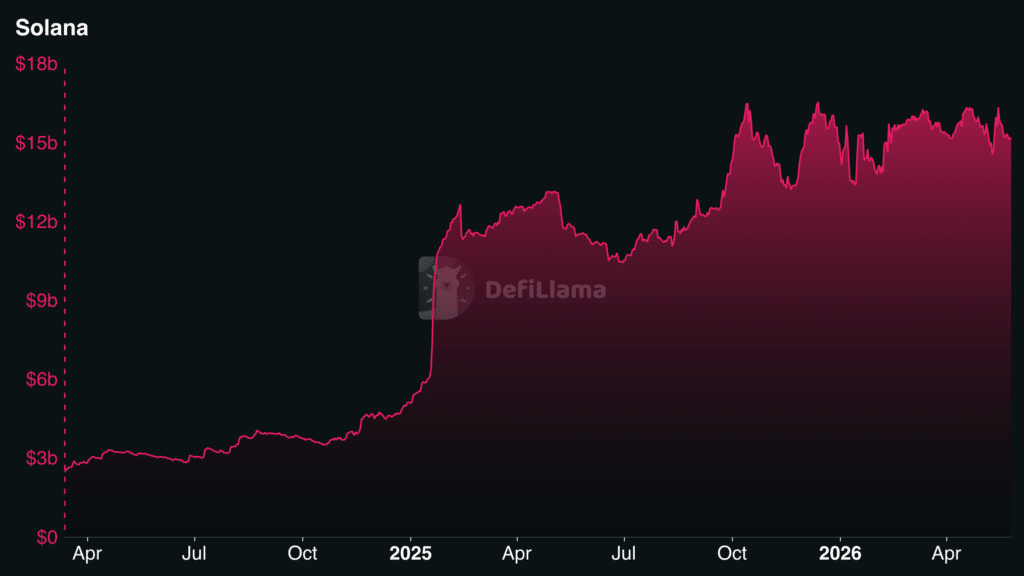
Here is what the data tells you: Circle has expanded the available dollar liquidity on Solana meaningfully and quickly. Here is what it does not tell you: where that capital goes next. The same $250 million can fund long positions in SOL, neutral market-making strategies, short positions on Solana-based perpetual DEXs, or simply sit idle in a wallet waiting for an opportunity.
Solana’s Q1 2026 network data shows the chain has been building genuine DeFi depth across lending markets and DEX volume, which gives incoming liquidity more places to land productively than in previous cycles.
How Does a $250M Liquidity Injection Affect SOL Price and DeFi Activity?
History offers a useful reference point. Previous large USDC mints on Solana, in the 100M–250M range, have repeatedly coincided with spikes in open interest on Solana-based perpetual DEXs and rising TVL in money markets.
The pattern isn’t causal in a simple sense, but it reflects how institutional and professional traders operate: they secure stablecoin positions on-chain before making directional moves, not after.
The Solana DeFi ecosystem gives this liquidity a lot of productive destinations. Protocols like Jupiter, Drift, and Raydium sit at the center of on-chain SOL trading and liquidity provision. When fresh USDC enters the network, it often flows into automated market maker pools, perpetual funding mechanisms, and lending markets, all of which tighten spreads, deepen order books, and reduce slippage for large traders.
That structural improvement in crypto liquidity conditions can itself attract further capital, creating a feedback loop that benefits the broader ecosystem.
Analysts tracking these events have described large USDC mints as “liquidity rotation events”, moments where market makers and funds arm themselves with dry powder before deploying it across spot and derivatives markets.
The bullish read is straightforward: more available dollar capital on Solana means more capacity for buyers to accumulate SOL and ecosystem tokens without moving the price adversely. The skeptical read is equally valid: that same capital can just as easily fund basis trades or short the rally, meaning the mint is a prerequisite for a move – not the move itself.
It’s also worth noting the broader infrastructure context. Solana’s Alpenglow upgrade, currently in validator testing, aims to reduce finality times further, which would make the network even more attractive for high-frequency DeFi activity where this kind of stablecoin liquidity gets deployed. More throughput capacity plus more available capital is a combination that tends to amplify both upside and downside price sensitivity.
The growing institutional presence on Solana adds another layer. Expanding real-world asset activity on Solana signals that the chain is attracting capital that tends to move in size, and that kind of institutional footprint makes large USDC mints more likely to represent structured deployment rather than speculative noise.
DISCOVER: Best Meme Coin ICOs to Invest in 2026
The post Solana Liquidity Surge: What a $250M USDC Injection Means for SOL Traders appeared first on 99Bitcoins.