Pacific Fusion is one step closer to commercializing fusion power after breaking ground Tuesday on a facility in New Mexico designed to generate as much energy as it consumes.
“It’s a huge step forward for commercial fusion power,” Carrie von Muench, co-founder and chief operating officer at Pacific Fusion, told TechCrunch. “To our knowledge, there’s no such facility being constructed in the country.”
While fusion power startups have been making rapid progress, no experiment or device has been able to generate enough power to offset the energy used by the facility, a milestone the industry calls net facility gain. One device, at the National Ignition Facility, has shown that controlled fusion reactions can generate more energy than they consume, but it is still far short of what would be needed to power the facility.
Pacific Fusion aims to hit net facility gain by 2030, with an eye toward operating a commercial power plant in the mid-2030s. Its commercial-scale reactor will need to generate about five times more energy than the demonstration system, in part to power the additional equipment a power plant requires.
The new facility, in Albuquerque, will test Pacific Fusion’s approach to fusion, which uses intense, tightly coordinated pulses of electricity to create a magnetic field around a fuel target about the size of a pencil eraser, squeezing it until the fuel atoms fuse.
The demonstration facility will be able to fire a handful of “shots” per day, Keith LeChien, co-founder and chief technical officer at Pacific Fusion, told TechCrunch. A full-size power plant will need to complete one shot per second.
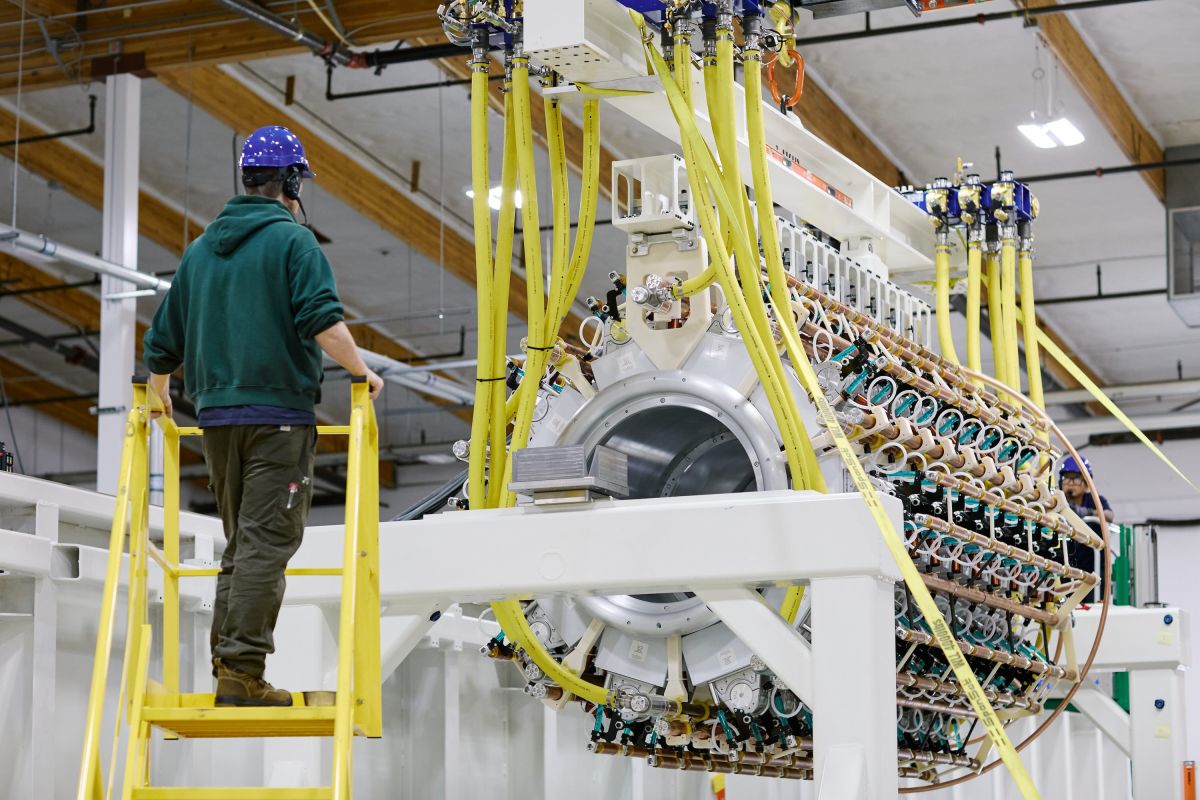
The pulses of electricity will be generated by 156 pulser modules, each of which contains 32 circular stages made up of 10 bricks. Each brick consists of two capacitors, which store power, and one switch, which releases it. Earlier this year, Pacific Fusion tested a one-third-scale version of a pulser module, which released 440 gigawatts of peak power in 80 nanoseconds. The results were good enough to greenlight the demonstration facility.
In addition to demonstrating net facility gain, Pacific Fusion’s new campus will also host national security-related experiments involving high-yield fusion. The U.S. government has other sites that conduct similar research, like the National Ignition Facility, though that facility is starting to show its age. Each pulse of the new demonstration system will generate on the order of 100 megajoules, about 10 times the output of the National Ignition Facility, LeChien said.
“This exists nowhere in the world,” he said. “China is building these types of facilities, and we intend to be the first to deliver them.”
Pacific Fusion has moved swiftly in the last few years. The company was founded in 2023, making it one of the younger entrants to the field. It’s also among the best funded fusion startups, having raised over $1 billion in a milestone-based Series A round.
The large, gated funding round allowed the company to plan farther in advance, eliminating the need to fundraise every few years, von Muench said. “I don’t think it would have been possible to move at this speed if we hadn’t designed the capital stack the way that we have.”
Pacific Fusion will need every advantage it can get in the race to deliver a commercial power plant. The field is filling up with similarly well-funded startups, including Commonwealth Fusion Systems, Helion Energy, Proxima Fusion, and Inertia Enterprises, all of which are aiming to connect a fusion power plant to the grid by the mid-2030s, if not earlier.
When you purchase through links in our articles, we may earn a small commission. This doesn’t affect our editorial independence.