Key Takeaways
- Musk considers a valuation above $1 quadrillion a possible outcome.
- His expansion strategy centers on reusable rockets and orbital AI.
- Saylor’s one-word reply replaces the first letter with the bitcoin symbol.
Musk Puts SpaceX’s Potential Beyond the Global Economy
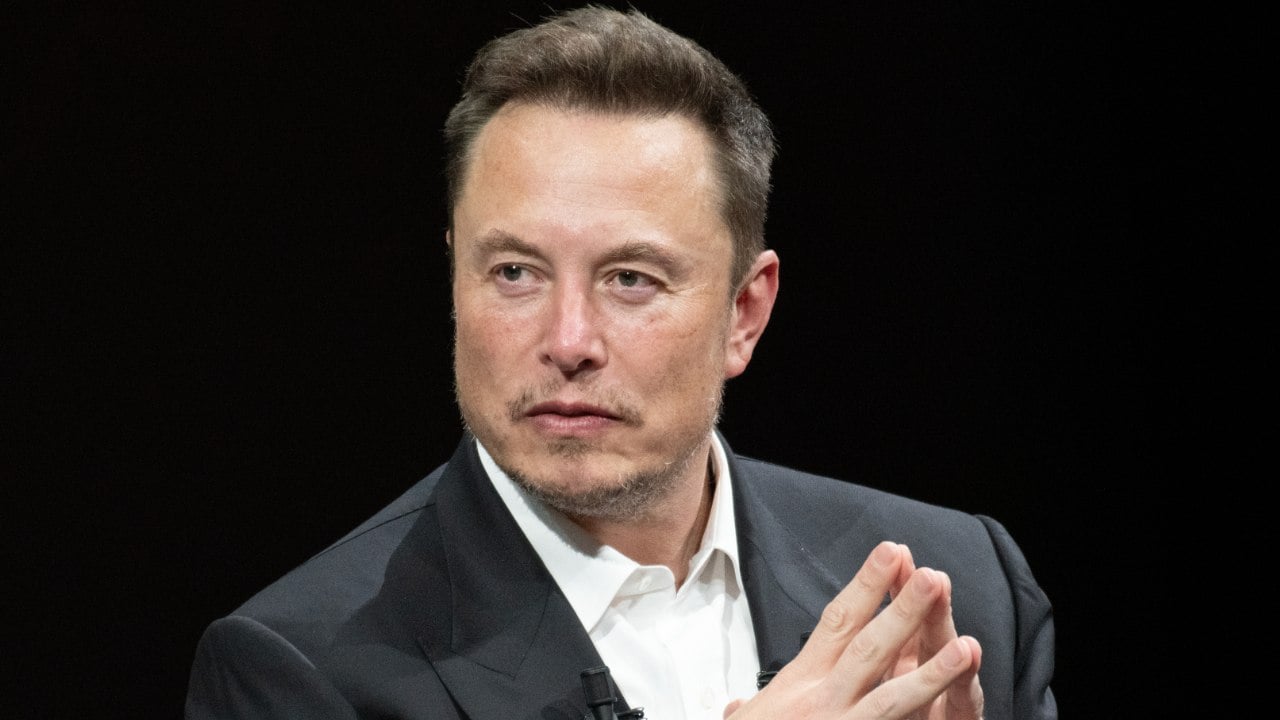
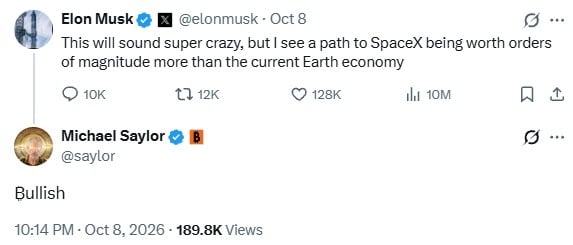
SpaceX could reach a valuation far beyond today’s global economy, CEO and Chairman Elon Musk argued on X on Oct. 8. Space Exploration Technologies Corp. (Nasdaq: SPCX) is a rocket, satellite communications, and artificial intelligence company. Musk wrote:
“This will sound super crazy, but I see a path to SpaceX being worth orders of magnitude more than the current Earth economy.”
The scale of that comparison depends on how economic value is measured, with annual production providing one reference. The International Monetary Fund’s April estimate places global economic output in 2026 at approximately $126.3 trillion. One order of magnitude means a tenfold difference. However, gross domestic product measures production over a year, while a company’s valuation represents the total value assigned to its shares.
A follow-up on Oct. 9 gave Musk’s outlook a numerical reference while retaining significant uncertainty about success. He described a valuation above $1 quadrillion, equivalent to $1,000 trillion, as a possible outcome he previously considered unattainable. He characterized the probability as accelerating from a tiny base and separately clarified that seeing a path did not express extreme confidence. The SpaceX CEO wrote:
“>$1000T now appears to me to be in the set of possible outcomes, whereas before I had thought it was not.”
His latest comments extend an earlier conditional valuation claim made July 9 during an exchange about an AI computing agreement involving Anthropic, the company behind the Claude AI assistant. That exchange also tied his valuation outlook to achieving SpaceX’s long-term goals.
Reusable Rockets and Solar-Powered AI Underpin Musk’s Vision
Musk’s economic argument centers on using solar energy beyond Earth to power much larger computing operations. In a June 8 discussion filed with the Securities and Exchange Commission (SEC), he outlined solar-powered AI computing in orbit. The proposal puts computers aboard satellites to process AI workloads. He identified three requirements: launch capacity, solar power, and computing chips.
Lower launch costs would make that expansion more practical by allowing the company to transport substantially more equipment into orbit. Musk’s space-based AI ambitions rely on Starship, SpaceX’s rocket system, achieving reuse of both stages with short turnaround times. On Sept. 28, it completed its first orbital flight and deployed 26 satellites for Starlink, the company’s satellite communications business.
Lunar manufacturing represents a further stage of the plan, potentially reducing the need to launch equipment from Earth. Musk described producing solar panels and radiators on the moon, then using an electromagnetic launcher to accelerate AI satellites into space through electromagnetic force. Its lower gravity and lack of atmosphere underpin that proposed approach.
Saylor Gives Musk’s SpaceX Outlook a Bitcoin Twist
The valuation exchange drew a one-word response from Michael Saylor, executive chairman of the largest bitcoin treasury company Strategy Inc. (Nasdaq: MSTR). His Oct. 8 reply read “₿ullish,” replacing the initial letter with the bitcoin symbol. The spelling connected his favorable reaction to the cryptocurrency while responding directly to Musk’s SpaceX outlook.
That reaction follows Saylor’s earlier comments linking SpaceX to corporate bitcoin ownership. On June 13, he congratulated Musk on the company’s public listing and counted SpaceX alongside Tesla among major technology businesses holding bitcoin. His “Mag8” grouping added SpaceX to the Magnificent Seven: Alphabet, Amazon, Apple, Meta, Microsoft, Nvidia, and Tesla.
The connection also extends to SpaceX’s balance sheet, which includes a substantial holding of the digital asset. Its quarterly filing disclosed 18,712 bitcoin as of June 30, unchanged from Dec. 31, 2025. Their acquisition cost, or cost basis, was $661 million. Their fair value, reflecting the market price on June 30, was approximately $1.098 billion.