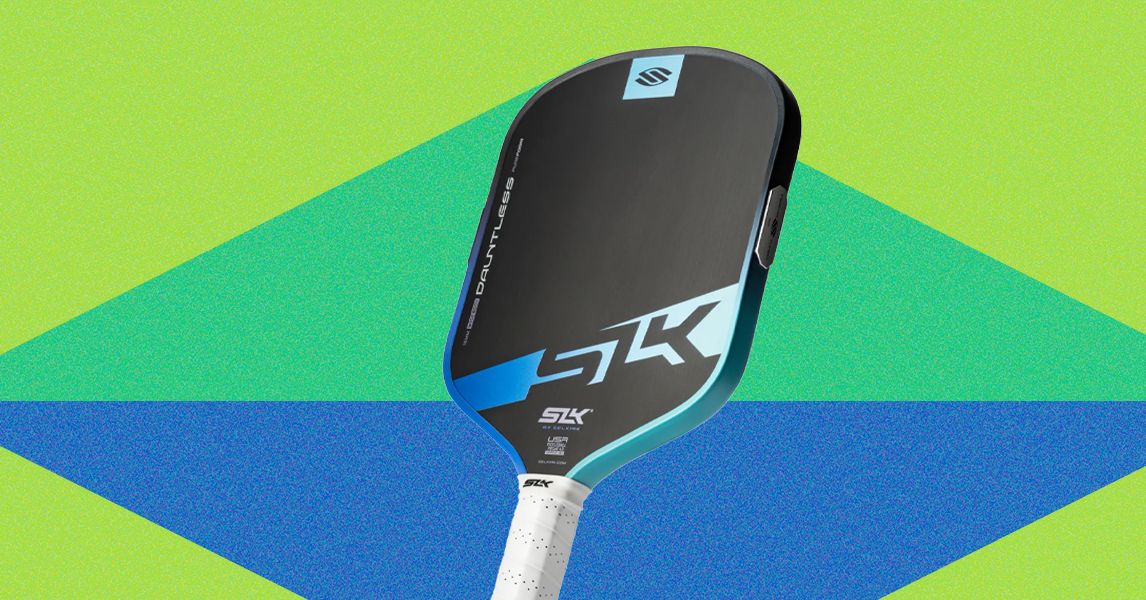
This is a versatile control paddle, and while it’s certainly capable of plenty of power, it’s best for someone who wants to improve the consistency of their game.
A cheaper option: The SLK Valkerie ($80) is about half the price of the Dauntless and has none of the new tech, but a very solid option for someone looking to buy a paddle to play once a month or on a vacation. You get a fiberglass face and a polymer core, so you won’t have as much grit to create lots of topspin, and it won’t last as long, but Selkirk makes nice paddles with comfortable grips and well-distributed weight. This paddle is very similar to SLK Evo, which was the first serious paddle I bought with my own money and have always liked (you get a carbon fiber face for more spin with the current edition of the Evo).
More power: A beginner player who wants more power should check out the Jojolemon Shark 002 ($100). (This is also classified as a control paddle, but I’m not a masher and rarely love paddles made for that style of play.) It has a face that uses carbon fiber and Kevlar for excellent spin. While this is a traditional thermoformed third-generation paddle and doesn’t have a full foam core, it has a foam injection on its perimeter that helps dampen vibrations and balance the striking surface while still offering what I would consider plenty of power.
The Best Expert Paddle Right Now: Paddletek Honeyfoam TKO-X
-
Photograph: Martin Cizmar
-
Photograph: Martin Cizmar


The new Paddletek Honeyfoam TKO-X ($250) is my overall favorite paddle after testing this year’s offerings from a dozen new brands. Paddletek paddles are known for being poppy, and past generations have been among my picks for power players. The Honeyfoam series, which is a full release version of the Reserve I tested last year, is a Goldilocks paddle precisely because it strikes a balance between what Paddletek has always done well and the benefits of foam cores. This is a paddle that makes you swing with total confidence—it’s got power and precision in equal measure. I have not tested another paddle that has as much pop as this one without sacrificing any control.

Photograph: Martin Cizmar
The TKO-X uses three different types of foam. The center is a low-density foam. The bottom half of the paddle has a denser EVA closed-cell foam that helps with energy return and shock absorption. Around the outside of the paddle is a third type of foam that helps create a sweet spot. The face is raw carbon, which offers great spin.
A cheaper option: The Onix Hype X ($90) doesn’t have a large and forgiving sweet spot like I’d want as a beginner, but its thermoformed honeycomb core has lots of pop while playing very consistently. This is a popular budget pick for advanced players for a reason, as it’s below $100 but has a carbon fiber face and weight distribution to favor harder strikers.
Other Interesting New Paddles
Here are some other innovative paddles I tested this year.

Photograph: Martin Cizmar
Reload: If you’re serious about spin, you know that the first thing to fail on any pickleball paddle is the textured carbon fiber face. The gritty texture that spins the ball at wonky angles wears off in as few as 50 games with the single paddle, at which point you’re at a disadvantage until you re-up your paddle. The Reload solves that problem. For $200, you’re basically getting three paddles and the option of buying fresh ones for $22 to $25. The paddle reloads very easily, and I had no issue putting on a new paper or with the sticky sheet coming unstuck.

Photograph: Martin Cizmar
SXY PKL: Another way to make paddles greener is to make them from natural materials (if you played pickleball in the days before its popularity exploded, you probably played with a wooden paddle). The SXY PKL nods in that direction with its bamboo face (the core is carbon). This paddle looks like nothing else on the court and gets attention from onlookers. The bamboo face is surprisingly gritty and feels like fine-grit sandpaper to me. It’s a solid paddle, though for $200 you can get better performance, if not more striking looks.
Scorpion Pioneer Plus LED: Wanna dodge the summer sun by playing in the evening, or just catch some attention on the court? The Scorpion LED paddle ($100 for a two-pack) charges via a USB-C port in the base of the handle and lights up in two dozen colors. It costs $50 per paddle and plays more like a $30 paddle, but I’ve used worse. It has a honeycomb core and a fiberglass face, so don’t expect much spin. There are included balls, or pair it with Franklin’s glow-in-the-dark ball.